
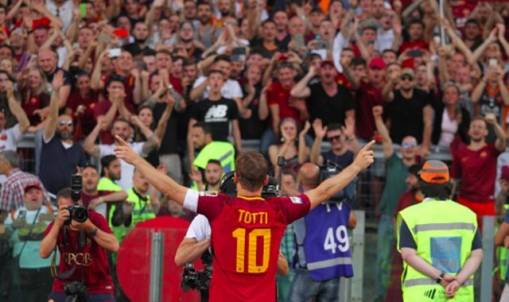
With the curtain finally falling on Francesco Totti’s playing career with Roma, the legacy left by the iconic No.10 will never be matched
As he pulled on his iconic No.10 shirt for the final time against Genoa on Sunday, Roma’s Francesco Totti received one last deafening roar from a Stadio Olimpico that he has made his own.
The man worshipped by all on the red and yellow side of the Eternal City has finally drawn his 24-year spell at the Lupi to a close. Wanting a change, or forced out by an ungrateful Giallorossi? Either way, it is the end of an era, but his legacy is set to loom large.
There is a whole generation of fans who simply do not know a Roma side without Er Pupone. Indeed, Roma and Totti have almost become synonymous, since the star debuted as a 16-year-old in March 1993.
The Giallorossi’s fans are not unaccustomed to homegrown players who devote themselves to the club. Bruno Conti has spent almost his entire adult life at Roma in some capacity, and has always been a popular figure.
Meanwhile, Giuseppe Giannini is still revered as Il Principe in the capital, whilst Daniele De Rossi has been marshalling the midfield for the best part of the last 16 years.
But there is, and can only be, one Totti, one iconic figure that captures the imagination of supporters more than any other. Nobody has encapsulated what it means to represent a club, and even a city, the way Totti has. Giannini was the prince, Totti is undoubtedly the king.
His legacy will be the dedication and service he offered his boyhood club for almost a quarter of a century. He will be remembered for turning down a Galacticos-era Real Madrid in 2004, and watching on as the Spaniards won four domestic league titles and two Champions Leagues to the meagre two Coppa Italias lifted with Roma.
Yet this loyalty has ensured a legacy of a different kind. Even Paolo Maldini, the epitome of a one-club man, was booed by AC Milan ultras in his farewell match. In contrast, it is near on impossible to find a Roma fan who doesn’t worship the ground Totti walks on.
It is easy to point to his unwavering loyalty to the Giallorossi as what defines Totti, but the 40-year-old has contributed so much more to the global game.
He ought to be remembered as a man who refused to rest on his laurels and was always ready to evolve as the game changed around him.
From a fresh-faced shadow striker as he broke into the first team under Carlo Mazzone, Totti soon became a twinkle-toed left forward in the all-out-attack of Zdenek Zeman.
His creativity as Fabio Capello’s trequartista inspired a star-studded Roma side to lift the Scudetto in 2001, but it was his later evolutions that will leave their mark.
As Luciano Spalletti struggled to find a fit striker in 2005-06, Totti was deployed as a lone forward but dropped deep to dictate play and create gaps for the team to exploit. It took Serie A by storm and Totti, entering his 30s, was a player reborn as the original ‘false nine’. The change yielded 26 goals and the European Golden Shoe, but the impact was wider reaching.
Totti’s intelligence in the role, and his incredible scoring feats, allowed him to carve it out as his own, and was part of the blueprint for the success of Barcelona and the Spanish national team at the turn of the decade. It is impossible to laud the triumphs of the false nine role without returning to the man who laid the groundwork for it.
Aside from his tactical intelligence and reading of the game, Totti’s combination of deft touches and inch-perfect passes, as well as a range of extraordinary goals, have set a new benchmark for a world class playmaker.
Indeed, some of the most imaginative and memorable goals scored in Italian football have come from Totti’s boots, and his pinpoint accuracy from the tightest of angles would be worthy of a snooker player.
Totti’s 250 Serie A goals are only bettered by Silvio Piola, and it is a feat that looks unlikely to be matched any time soon.
Yet, for all the enthralling moments, Totti’s trophy haul is threadbare. Despite offers from elite European clubs the captain stuck by Roma, prompting suggestions of a lack of ambition.
The Giallorossi star shone brightest when Serie A needed him most, particularly as it struggled to keep up with the Premier League and La Liga in the mid-noughties. Totti often struggled to gain the respect from foreign audiences and pundits that his talent so clearly deserves, with a failure to win silverware or move to a more competitive team used as a stick to beat him with.
Hindered by Roma’s lack of competitiveness in European competition, the dip in Serie A audiences meant it was easy to write Totti off. As calcio’s force waned, the critics sharpened their knives.
However, those who remained loyal to the Italian game were treated to mesmerising goals, assists and performances from Er Pupone.
On the international stage, Totti was instrumental in Italy’s 2006 World Cup win. A broken leg sustained in February of that year looked to have ruled him out, but the playmaker sensationally recovered in time to play a starring role in the Azzurri’s triumph. Although half fit and almost playing only on one leg, Il Gladiatore secured four assists and featured in every match.
Whilst this ought to be enough to secure his legacy for the Italian national team, there is a sense that Totti should have achieved so much more. As a 23-year-old vying for top billing with Alessandro Del Piero, the Roma star was superb throughout Euro 2000 and named man of the match as Italy lost in the final.
Yet between the heartbreak against France and the World Cup triumph six years later, Totti endured a miserable spell with Italy. At the prime of his career and with the world at his feet, much was expected from the Roman, but he was sent off for diving at the 2002 World Cup, before being handed a lengthy ban for spitting at Denmark’s Christian Poulsen at Euro 2004.
Whilst, these blots have often haunted Totti, it is telling that since his international retirement in 2006 successive Azzurri coaches have faced vocal calls to attempt to convince him to come back into the fold. Even as recently as the 2014 World Cup, Totti was being suggested as a genuine contender for Cesare Prandelli’s squad.
Regardless of any international glory though, Totti has been, and always will be, associated with Roma. Whether the Giallorossi are ready for life without their talisman remains to be seen, but the stars of tomorrow are set to live in his considerable shadow, and the transition may prove difficult.
It is often said that no player is ever bigger than a club, but Totti is perhaps the closest there is to an exception to the rule.
The famous ‘No Totti, No Party’ banner will continue to be unfurled, but the show must go on, however painful it will be for fans of a game truly made beautiful by Francesco Totti.
Source: forzaitalianfootball.com